Last week was all about Future Projections and modelling and this week is all about the impact of climate change on natural systems.
Impact on land systems - The Cryosphere
As the earth warms sea levels are set to rise and this is currently due to thermal expansion of the oceans as well as melting mountain glaciers and small ice caps. However, Greenland and Antarctica could also be contributors as they currently make up 99% of the worlds glacier ice on earth. Which equates to 65 meters of sea level rise.
Greenland
Greenland has shown a rapid response to global warming over the last 2 decades. Ice loss have increased as well as glaciers speeding up and thinning. Half the mass loss is due to surface melt and the other is due to carving - blocks of ice brewing off into icebergs into the sea.
In summer, half of Greenlands ice sheet melts naturally. In 2012, the melt extent was the largest in the satellite era, extending up to 97% of the ice sheet surface and lasting two months longer than the 1979 to 2011 mean. As well as ice melt, a lot of the mass loss has been due to ice flowing to the margins and breaking off into icebergs, meltwater draining to the bed (basal lubrication) or forming lakes on the surface. If lakes are formed then these will absorb solar radiation and heat the ice surrounding it causing it to melt further.
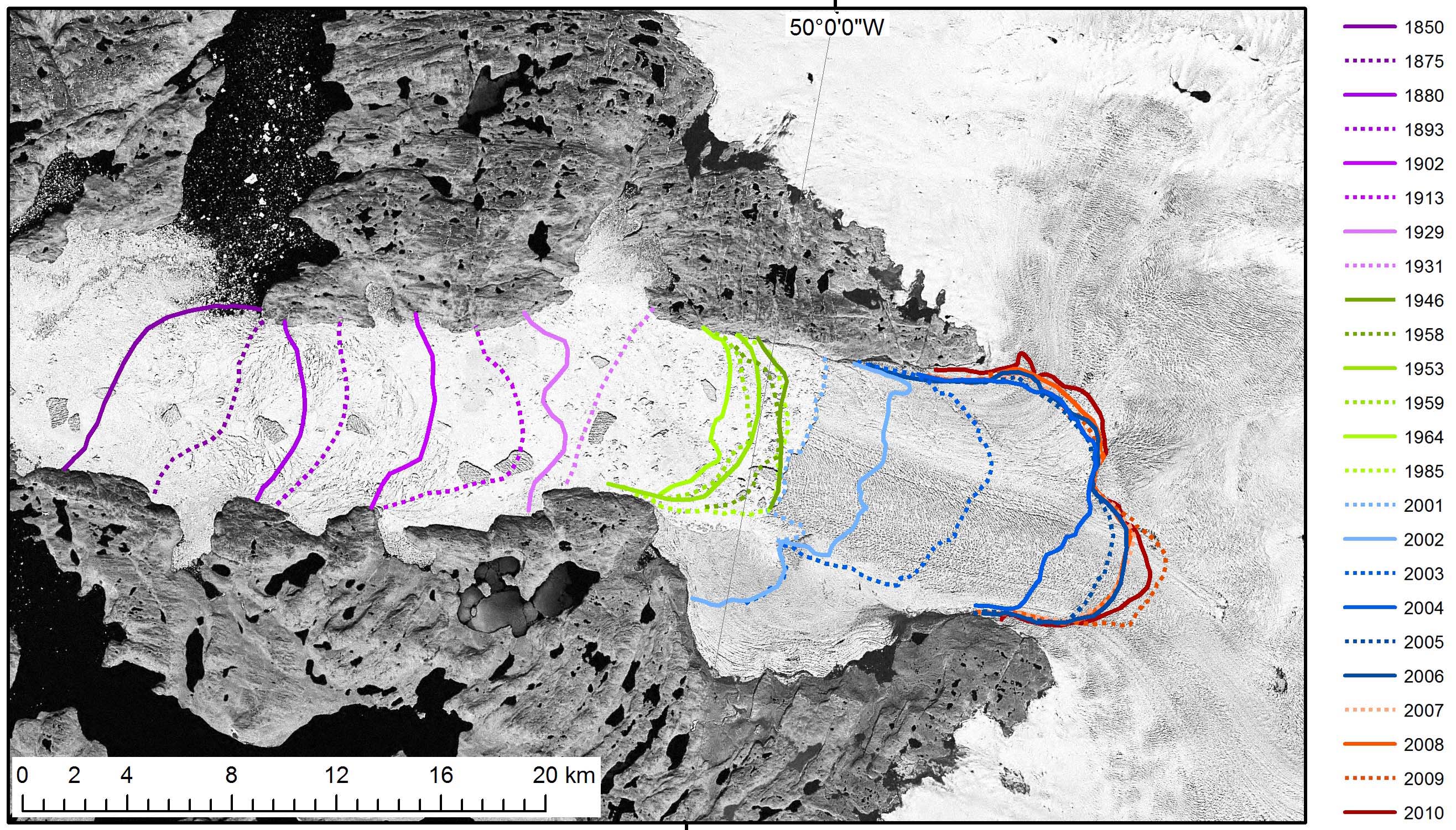
Greenland at Jakobshavns Isbrae. The image below shows the retreat of the ice tongue (An ice tongue is a long and narrow sheet of ice projecting out from the coastline. An ice tongue forms when a valley glacier moves very rapidly out into the ocean or a lake). Over the years the tongue has been retreating. The ice tongue acts as a buttress for the main ice sheet and with the break up of the tongue the ice sheet will advance and spread towards the sea, thinning, melting and and breaking off. With the changes in the ice sheet this will also effect the reflection of solar radiation (albedo effect).
Antartica
Antartica has many ice shelves that buttress the main ice sheet. The West Antarctic ice sheet is much more unstable than the East as most of the sheet lies beneath sea level making it a marine ice sheet.Taken from antarticglaciers.org: The Marine Ice Sheet Instability hypothesis is that atmospheric and oceanic warming could result in increased melting and recession at the grounding line on a reverse slope gradient. This would result in the glacier becoming grounded in deeper water and a greater ice thickness. This is because the grounding line in this region has a reverse-bed gradient, becoming deeper inland. Stable grounding lines cannot be located on upward-sloping portions of seafloor[13]. Ice thickness at the grounding line is a key factor in controlling flux across the grounding line[3], so thicker ice grounded in deeper water would result in floatation, basal melting, increased iceberg production, and further retreat within a positive feedback loop. This would result in a rapid melting of the West Antarctic Ice Sheet, triggering rapid sea level rise.

As i'm behind on the course (2 weeks) i've had to copy and paste the information from the transcript to cover this :(
Ocean acidification
The oceans cover 70% of the planet's surface. But because they're deep, they actually
contain 99% of the living space for animals on our planet. So they contain a large proportion
of the global biodiversity. The ocean plays a really important role in the carbon cycle. Carbon dioxide is really
soluble in sea water. And the ocean actually absorbs about a third of that atmospheric
carbon dioxide. As it dissolves into the sea water, it causes a series of chemical reactions,
which is now leading to ocean acidification. As carbon dioxide
dissolves into sea water, it reacts with water to form carbonic acid. This carbonic acid is really unstable, and quickly dissociates into two irons, bicarbonate, and
hydrogen ions. And it's the concentration of hydrogen ions in seawater that determine its
pH. The pH of seawater at the moment is about 8.1.
Since the Industrial Revolution, the pH of the ocean has fallen by about 0.1 of a pH unit. If we continue to release carbon dioxide into our atmospheres, at the rates that we're
predicting at the moment, we're looking at a pH change of about 0.3 to 0.4 of a pH unit by
the end of this century.
Ocean acidification affects:
What are the most important themes you have learned this week?
Ocean acidification affects:
- Calcification - the accumulation of calcium salts in a body tissue
- Increased carbon dioxide levels in seawater has the potential to alter the basic physiology of any marine organism
- The reproduction process of marine invertebrates
- Acidification reacting with pollution in the oceans
Reflection
What are the most important themes you have learned this week?
Lots about glaciers and lots about ocean acidification - they are really affected by climate change
What aspect of this week did you find difficult.
A lot of it - I found the glaciers and the ocean acidification hard - slightly out of my depth but this is because I also didn't have time to concentrate as much this week
One in every three breaths that we
take comes from oxygen produced by phytoplankton living in the oceans. What a fact... I would have never of guessed that. pretty fascinating.
Looking up about the changes in Greenland and what the ice sheet and the ice tongue actually looked like
Are there any web sites or other online resource that you found particularly useful in furthering your knowledge and understanding?
Are there any web sites or other online resource that you found particularly useful in furthering your knowledge and understanding?
See below:
http://polarportal.dk/en/groenlands-indlandsis/nbsp/isens-overflade/
http://www.antarcticglaciers.org/glaciers-and-climate/ice-ocean-interactions/marine-ice-sheets/
http://explore.glacierworks.org/en
http://polarportal.dk/en/groenlands-indlandsis/nbsp/isens-overflade/
http://www.antarcticglaciers.org/glaciers-and-climate/ice-ocean-interactions/marine-ice-sheets/
http://explore.glacierworks.org/en
http://www.whoi.edu/OCB-OA/FAQs
https://www.youtube.com/watch?v=5cqCvcX7buo&feature=youtu.be

No comments:
Post a Comment