Making future projections and modelling future scenarios
The MET office are the worlds leading centre for climate modelling and prediction (as well as them primarily being the UK's weather forecaster) because the processes that you need to use to predict climate change are the same as weather prediction but instead of looking at the short term they need to look at the longer term - 250 years for a climate simulation. There are additional elements which need to be included in the models such the tidal changes, carbon trapped in vegetation etc but the ideas are the same.
2 million calculations are needed at every step, which is every 20 minutes. There are many equations that are required and some of these are already known such as the relationship between the atmosphere and the oceans but there are others which need to worked out along the way. You need a super computer to work all these calculations out and it takes 3 months to do...wow!
Why should be trust these models? We feed the model with information; natural factors such as sun variance and volcanic eruptions as well as human factors with the increase in CO2 with deforestation and burning of fossil fuels. If the models are run with just the natural factors all is correct until 1970 but after that it shows the climate getting cooler, once the human factors are added then the models therefore gives us confidence that its right. This modelling is called Fingerprinting which has allowed the IPPC to state that 90% chance that the climate warming is from the effect of human activities.
Climate models predict that the earths temperature will increase by about 2-6 degrees by the end of the 21st Century depending on how much the carbon emissions grow by.

CO2 emissions will vary in the future and it is hard to predict what will happen in terms of technology changes and population growth.
It takes decades to centuries for Earth to fully react to increases in greenhouse gases. Carbon dioxide, among other greenhouse gases, will remain in the atmosphere long after emissions are reduced, contributing to continuing warming.
These considerations mean that people won’t immediately see the impact of reduced greenhouse gas emissions. Even if greenhouse gas concentrations stabilized today, the planet would continue to warm by about 0.6°C over the next century because of greenhouses gases already in the atmosphere.
IPCC Fifth Assessment Report 2013 (AR5)
The Fifth Assessment Report (AR5) is the most comprehensive assessment of scientific knowledge on climate change since 2007 when the Fourth Assessment Report (AR4) was released. It was released in four parts between September 2013 and November 2014. AR5 is made up of the full reports prepared by theWorking Groups (I, II and III) and their Summaries for Policymakers as well as the Synthesis Report.
A summary of the report included the following statements:
Warming of the climate system is unequivocal, and since the 1950s, many of the observed changes are unprecedented over decades to millennia. The atmosphere and ocean have warmed, the amounts of snow and ice have diminished, sea level has risen, and the concentrations of greenhouse gases have increased.
Total radiative forcing is positive, and has led to an uptake of energy by the climate system. The largest contribution to total radiative forcing is caused by the increase in the atmospheric concentration of CO2 since 1750.
Human influence on the climate system is clear. This is evident from the increasing greenhouse gas concentrations in the atmosphere, positive radiative forcing, observed warming, and understanding of the climate system.
Continued emissions of greenhouse gases will cause further warming and changes in all components of the climate system. Limiting climate change will require substantial and sustained reductions of greenhouse gas emissions.
Geoengineeing
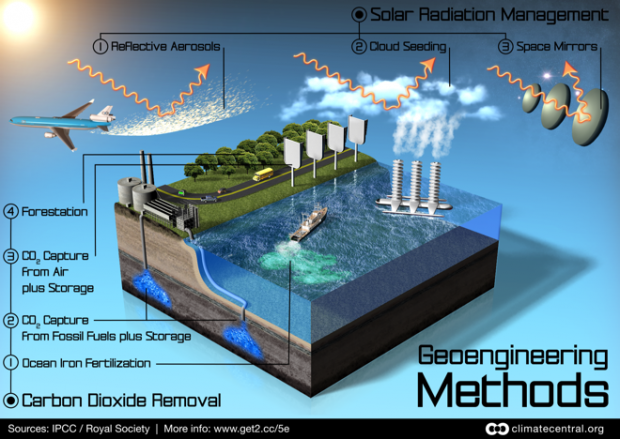
Geoengineering it using technology to control the climate. It includes carbon dioxide removal, carbon capture. Methods for these are through bioenergy, carbon sequestration, iron fertilisation, atmospheric CO2 scrubbers, afforestation.
I checked out the space mirrors which were mentioned in the diagram and it's hard to believe we would consider such a method...but it's quite possible things may led to this eventually. Even the IPCC mentioned this as a possible method. Was well as space mirrors there are other ways to manage solar radiation, these include releasing "stratospheric aerosols"in the upper atmosphere and using earth-bound reflectors or urban roof reflectors.
An diagram showing what the best method to use is show below, as produced by the Royal Society.

There are pro's and con's whether we should be using these geoengineering methods. They are likely to cost a considerable amount and do they actually work and will they any negative impacts on the climate? Is carbon capture considered in the same way. I personally think we should concentrate on our activities and reduce our emissions and change they way we behave. Surely we are not even there at the moment with the continual use of fossil fuels as a primary source of fuel and the lack of alternative energy in our day to day lives. I wouldn't dismiss technology and believe that these geoengineering methods may need to be implemented but do I want to see balloons in the air, see space mirrors launched into the upper atmosphere and know that we are purposely releasing aerosols into the stratosphere before we even sort out our bad habits..of course not.
Reflection
- What are the most important themes you have learned this week? - Geoengineering.
- What aspect of this week did you find difficult? - trying to understand if the climate models can really help us out if there are so many variables
- What did you find most interesting? And why? - Geoengineering and the crazy ideas that are already being considered..seriously.
- Was there something that you learned this week that prompted you to do your own research? - just to look up what carbon capture was and what the different methods entailed
- Are there any web sites or other online resource that you found particularly useful in furthering your knowledge and understanding?
links
http://www.ft.com/cms/s/0/a187f0ac-21e7-11e3-9b55-00144feab7de.html#axzz3RBI3mUid
http://www.bbc.co.uk/news/science-environment-19371833
http://www.bbc.co.uk/news/science-environment-19371833

No comments:
Post a Comment