Saturday, 28 February 2015

Week 6 - Impacts on human systems

Last week was pretty hard to understand as a lot of the glacier information was hard to work out and ocean acidification was new to me, so there was a lot going on to fill up my brain. Impacts on the human environment and systems is more connected to what we see everyday and links in with studies I did at university back in 2000...


Impacts on human systems

In the UK, the building industry is responsible for over 50% of carbon emissions, and in some economically-developed countries, the figure is even higher. There are 3 concepts:

Urban heat islands

This was first discovered by the large expanse of buildings in our urban areas are very efficient at absorbing and reflecting heat. The larger and taller the buildings, the more heat they are capable of trapping at street level bouncing backwards and forwards between buildings. Buildings block wind, which inhibits cooling by convection and increased drainage of urban areas, sewers carry away water, preventing evaporation.


Heat islands are not a newly-discovered phenomenon. Indeed, using simple mercury thermometers, weather watchers have noticed for some two centuries that cities tend to be warmer than surrounding rural areas. The island is affected but the size of the city, population, number of building etc.


Heat waves

A heat wave is a period of hot weather prolonged over several days. In 2003 almost 70, 000 people died in Europe due to the hot weather either from hyperthermia, dehydration and heat stroke. A large proportion of people also died at the top floor of high rise building which can be linked to the concept of thermal comfort.


Thermal comfort

Your body is producing approximately 100 watts of heat even just sitting down and this amount increases as you become more active.  As you get hotter you adjust your environment such as remove layers of clothes, open a window, fan cold air on you or perspire. The rate of heat loss depends on the environmental conditions, temperature, humidity, and air movement.


Climate change and food security

The global population stands at 7 billion. We predict by 2050, we will reach 9.2 billion people on this planet. 86% of these people will be living in less economically developed countries so the challenge is how we will feed everyone! The four staple foods are rice, maize, wheat and potatoes. These provide essential carbohydrates in our diet with rice being the most important because it provides the main daily calorie intake for 50% of the world's population. Because of the growing population we need to ensure that food production doubles by 2050 and we need to ensure there is a secure system for this to happen.

There are a number of factors which are affecting food production/crops, which are largely due to climate change. These include drought, changing rainfall patterns, flooding, fires and crop diseases.


Crop disease

Since the 1960s, we've undergone what is termed the Green Revolution. 
  1. The Green Revolution refers to a series of research, and development, and technology transfer initiatives, occurring between the 1940s and the late 1960s, that increased agricultural production worldwide, particularly in the developing world, beginning most markedly in the late 1960s.
The Green Revolution haas meant the increased use of fertilisers, herbicides, pesticides, and fungicides, as well as greater farm mechanisation and intensification. It has also meant the introduction of high yielding varieties of our crops in vast hectarages of monocultures. If pathogens are introduced to these monoculture environments they can wipe out an entire crop in one go. Examples of this happening are:
Ash dieback fungus
Irish potato famine

Fungi is becoming a big problem pathogen and there are strains of fungi which are affecting our staple food supply (rice/wheat/maize). And the cost of loss of crop caused by these fungi to the global economy is $60 billion US per annum. There is a gradual shift of pathogens affecting crops towards the higher latitudes. Since 1960 the mean shift has been in the region of three kilometres per year. Fungi are moving over 7 kilometres per year polewards in a warming world.


Reflection:

What are the most important themes you have learned this week?

Food security - i'd never hear of this before and seems like it's a pretty big thing which we really need to look out on a global scale. It's shocking how much we are producing and wasting whilst people in other countries are starving

What aspect of this week did you find difficult?

Nothing too bad this week, I suppose i didn't initially get some of the stuff mentioned on the video for food security but once i read the transcript and read other articles it made more sense

What did you find most interesting? And why?

The heat wave stuff and how the urban environment is affected.

Was there something that you learned this week that prompted you to do your own research?

Food security - looked at some news articles to strengthen my understanding and out things in perspective

Are there any web sites or other online resource that you found particularly useful in furthering your knowledge and understanding?

http://www.nasa.gov/topics/earth/features/heat-island-sprawl.html
http://earthobservatory.nasa.gov/IOTD/view.php?id=36227
http://www.theguardian.com/environment/2012/sep/19/climate-change-affect-food-production
http://www.foodsecurity.ac.uk/index.html

Tuesday, 24 February 2015

Week 5 - Impacts on natural systems

OK a week late to week 5 with a lot of other learners onto week 6 already but life does get in the ways sometimes but i'm determined to crack on catch up...

Last week was all about Future Projections and modelling and this week is all about the impact of climate change on natural systems.

Impact on land systems - The Cryosphere

  1. Frozen water is found on the Earth's surface primarily as snow cover, freshwater ice in lakes and rivers, sea ice, glaciers, ice sheets, and frozen ground and permafrost (permanently frozen ground). The residence time of water in each of these cryospheric sub-systems varies widely.
As the earth warms sea levels are set to rise and this is currently due to thermal expansion of the oceans as well as melting mountain glaciers and small ice caps. However, Greenland and Antarctica could also be contributors as they currently make up 99% of the worlds glacier ice on earth. Which equates to 65 meters of sea level rise.


Greenland

Greenland has shown a rapid response to global warming over the last 2 decades. Ice loss have increased as well as glaciers speeding up and thinning. Half the mass loss is due to surface melt and the other is due to carving - blocks of ice brewing off into icebergs into the sea. 

In summer, half of Greenlands ice sheet melts naturally. In 2012, the melt extent was the largest in the satellite era, extending up to 97% of the ice sheet surface and lasting two months longer than the 1979 to 2011 mean. As well as ice melt, a lot of the mass loss has been due to ice flowing to the margins and breaking off into icebergs, meltwater draining to the bed (basal lubrication) or forming lakes on the surface. If lakes are formed then these will absorb solar radiation and heat the ice surrounding it causing it to melt further.


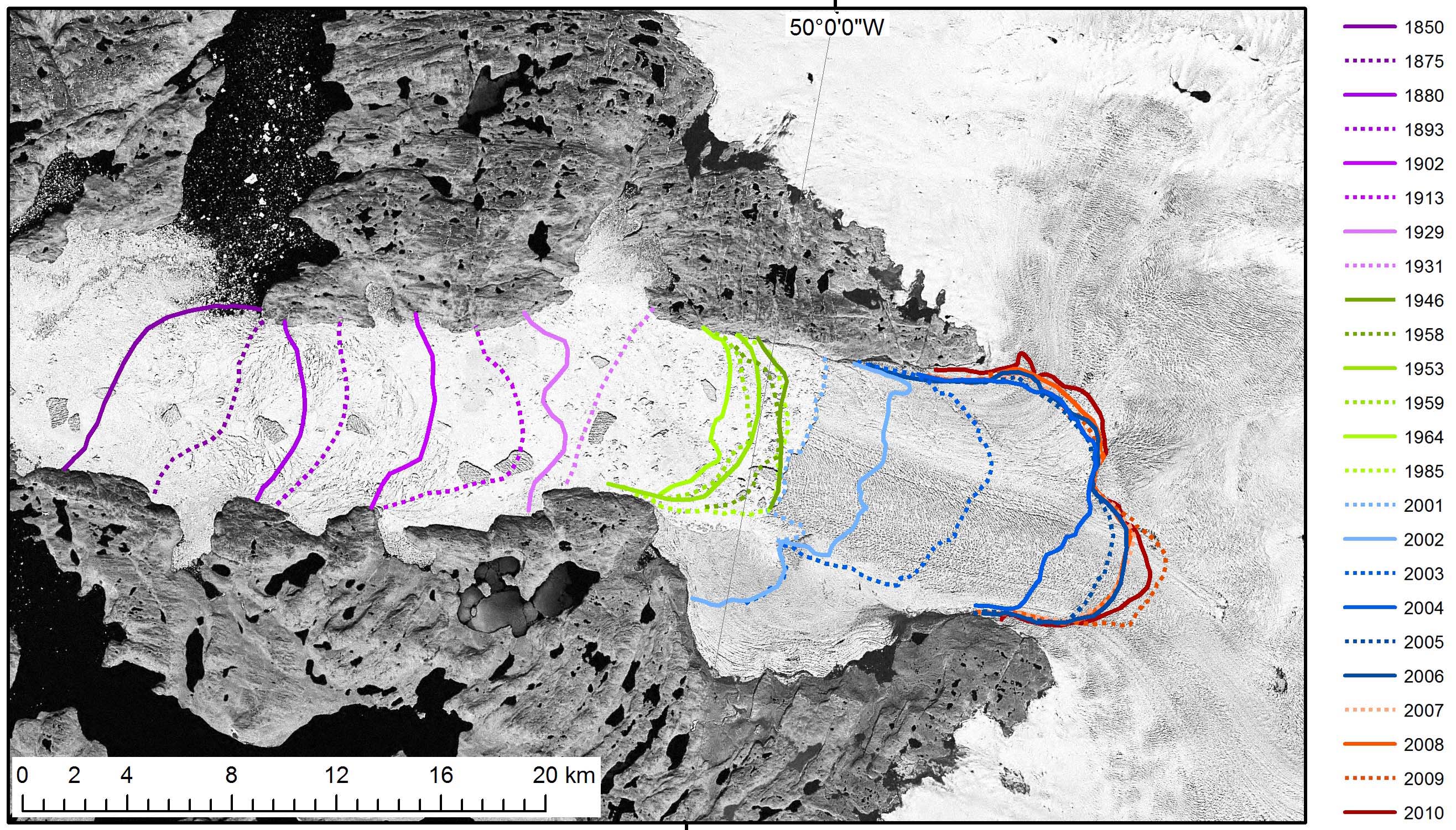
Greenland at Jakobshavns Isbrae. The image below shows the retreat of the ice tongue (An ice tongue is a long and narrow sheet of ice projecting out from the coastline. An ice tongue forms when a valley glacier moves very rapidly out into the ocean or a lake). Over the years the tongue has been retreating. The ice tongue acts as a buttress for the main ice sheet and with the break up of the tongue the ice sheet will advance and spread towards the sea, thinning, melting and and breaking off. With the changes in the ice sheet this will also effect the reflection of solar radiation (albedo effect).


Antartica

Antartica has many ice shelves that buttress the main ice sheet. The West Antarctic ice sheet is much more unstable than the East as most of the sheet lies beneath sea level making it a marine ice sheet. 

Taken from antarticglaciers.org: The Marine Ice Sheet Instability hypothesis is that atmospheric and oceanic warming could result in increased melting and recession at the grounding line on a reverse slope gradient. This would result in the glacier becoming grounded in deeper water and a greater ice thickness. This is because the grounding line in this region has a reverse-bed gradient, becoming deeper inland.  Stable grounding lines cannot be located on upward-sloping portions of seafloor[13]. Ice thickness at the grounding line is a key factor in controlling flux across the grounding line[3], so thicker ice grounded in deeper water would result in floatation, basal melting, increased iceberg production, and further retreat within a positive feedback loop. This would result in a rapid melting of the West Antarctic Ice Sheet, triggering rapid sea level rise.


As i'm behind on the course (2 weeks) i've had to copy and paste the information from the transcript to cover this :(


Ocean acidification


The oceans cover 70% of the planet's surface. But because they're deep, they actually contain 99% of the living space for animals on our planet. So they contain a large proportion of the global biodiversity. The ocean plays a really important role in the carbon cycle. Carbon dioxide is really soluble in sea water. And the ocean actually absorbs about a third of that atmospheric carbon dioxide. As it dissolves into the sea water, it causes a series of chemical reactions, which is now leading to ocean acidification. As carbon dioxide dissolves into sea water, it reacts with water to form carbonic acid. This carbonic acid is really unstable, and quickly dissociates into two irons, bicarbonate, and hydrogen ions. And it's the concentration of hydrogen ions in seawater that determine its pH. The pH of seawater at the moment is about 8.1.


Since the Industrial Revolution, the pH of the ocean has fallen by about 0.1 of a pH unit. If we continue to release carbon dioxide into our atmospheres, at the rates that we're predicting at the moment, we're looking at a pH change of about 0.3 to 0.4 of a pH unit by the end of this century.

Ocean acidification affects:


  • Increased carbon dioxide levels in seawater has the potential to alter the basic physiology of any marine organism 
  • The reproduction process of marine invertebrates
  • Acidification reacting with pollution in the oceans


Reflection


What are the most important themes you have learned this week?
Lots about glaciers and lots about ocean acidification - they are really affected by climate change

What aspect of this week did you find difficult. 
A lot of it - I found the glaciers and the ocean acidification hard - slightly out of my depth but this is because I also didn't have time to concentrate as much this week

What did you find most interesting? And why?

One in every three breaths that we take comes from oxygen produced by phytoplankton living in the oceans.  What a fact... I would have never of guessed that. pretty fascinating.


Was there something that you learned this week that prompted you to do your own research?
Looking up about the changes in Greenland and what the ice sheet and the ice tongue actually looked like

Are there any web sites or other online resource that you found particularly useful in furthering your knowledge and understanding?
See below:
http://polarportal.dk/en/groenlands-indlandsis/nbsp/isens-overflade/
http://www.antarcticglaciers.org/glaciers-and-climate/ice-ocean-interactions/marine-ice-sheets/
http://explore.glacierworks.org/en
http://www.whoi.edu/OCB-OA/FAQs
https://www.youtube.com/watch?v=5cqCvcX7buo&feature=youtu.be


Tuesday, 10 February 2015

Week 4 - Future Projections

Back to the grindstone this week, I have the whole weekend to go through this weeks course so I should have some better notes...


Making future projections and modelling future scenarios


The MET office are the worlds leading centre for climate modelling and prediction (as well as them primarily being the UK's weather forecaster) because the processes that you need to use to predict climate change are the same as weather prediction but instead of looking at the short term they need to look at the longer term - 250 years for a climate simulation. There are additional elements which need to be included in the models such the tidal changes, carbon trapped in vegetation etc but the ideas are the same.

2 million calculations are needed at every step, which is every 20 minutes. There are many equations that are required and some of these are already known such as the relationship between the atmosphere and the oceans but there are others which need to worked out along the way. You need a super computer to work all these calculations out and it takes 3 months to do...wow!

Why should be trust these models? We feed the model with information; natural factors such as sun variance and volcanic eruptions as well as human factors with the increase in CO2 with deforestation and burning of fossil fuels. If the models are run with just the natural factors all is correct until 1970 but after that it shows the climate getting cooler, once the human factors are added then the models therefore gives us confidence that its right. This modelling is called Fingerprinting which has allowed the IPPC to state that 90% chance that the climate warming is from the effect of human activities.

Climate models predict that the earths temperature will increase by about 2-6 degrees by the end of the 21st Century depending on how much the carbon emissions grow by.


Climate feedback systems can more the double the effect caused by carbon emissions. These feedbacks include: water vapour, clouds, snow and ice and the carbon cycle.
CO2 emissions will vary in the future and it is hard to predict what will happen in terms of technology changes and population growth.

It takes decades to centuries for Earth to fully react to increases in greenhouse gases. Carbon dioxide, among other greenhouse gases, will remain in the atmosphere long after emissions are reduced, contributing to continuing warming. 

These considerations mean that people won’t immediately see the impact of reduced greenhouse gas emissions. Even if greenhouse gas concentrations stabilized today, the planet would continue to warm by about 0.6°C over the next century because of greenhouses gases already in the atmosphere.


IPCC Fifth Assessment Report 2013 (AR5)

The Fifth Assessment Report (AR5) is the most comprehensive assessment of scientific knowledge on climate change since 2007 when the Fourth Assessment Report (AR4) was released. It was released in four parts between September 2013 and November 2014. AR5 is made up of the full reports prepared by theWorking Groups (I, II and III) and their Summaries for Policymakers as well as the Synthesis Report. 


A summary of the report included the following statements:

Warming of the climate system is unequivocal, and since the 1950s, many of the observed changes are unprecedented over decades to millennia. The atmosphere and ocean have warmed, the amounts of snow and ice have diminished, sea level has risen, and the concentrations of greenhouse gases have increased.

Total radiative forcing is positive, and has led to an uptake of energy by the climate system. The largest contribution to total radiative forcing is caused by the increase in the atmospheric concentration of CO2 since 1750.

Human influence on the climate system is clear. This is evident from the increasing greenhouse gas concentrations in the atmosphere, positive radiative forcing, observed warming, and understanding of the climate system.

Continued emissions of greenhouse gases will cause further warming and changes in all components of the climate system. Limiting climate change will require substantial and sustained reductions of greenhouse gas emissions. 

Geoengineeing 


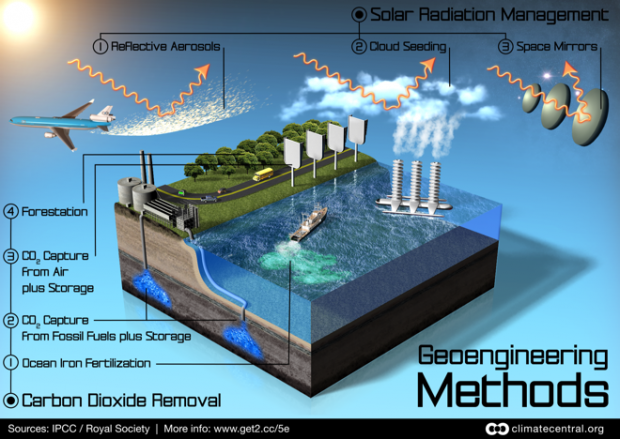
Geoengineering it using technology to control the climate. It includes carbon dioxide removal, carbon capture. Methods for these are through bioenergy, carbon sequestration, iron fertilisation, atmospheric CO2 scrubbers, afforestation.


I checked out the space mirrors which were mentioned in the diagram and it's hard to believe we would consider such a method...but it's quite possible things may led to this eventually. Even the IPCC mentioned this as a possible method. Was well as space mirrors there are other ways to manage solar radiation, these include releasing "stratospheric aerosols"in the upper atmosphere and using earth-bound reflectors or urban roof reflectors.

An diagram showing what the best method to use is show below, as produced by the Royal Society.


There are pro's and con's whether we should be using these geoengineering methods. They are likely to cost a considerable amount and do they actually work and will they any negative impacts on the climate? Is carbon capture considered in the same way. I personally think we should concentrate on our activities and reduce our emissions and change they way we behave. Surely we are not even there at the moment with the continual use of fossil fuels as a primary source of fuel and the lack of alternative energy in our day to day lives. I wouldn't dismiss technology and believe that these geoengineering methods may need to be implemented but do I want to see balloons in the air, see space mirrors launched into the upper atmosphere and know that we are purposely releasing aerosols into the stratosphere before we even sort out our bad habits..of course not.


Reflection

  1. What are the most important themes you have learned this week? - Geoengineering.
  2. What aspect of this week did you find difficult? - trying to understand if the climate models can really help us out if there are so many variables
  3. What did you find most interesting? And why? - Geoengineering and the crazy ideas that are already being considered..seriously.
  4. Was there something that you learned this week that prompted you to do your own research? - just to look up what carbon capture was and what the different methods entailed
  5. Are there any web sites or other online resource that you found particularly useful in furthering your knowledge and understanding?

links


Tuesday, 3 February 2015

Week 3 - We are changing the climate!

So this is what we want to know. I know that we changing the climate but I want to know how we know we are changing the climate. If I have to go out in my day job and explain the negative impact peoples activities have on the climate then I want to have the ammunition to explain why, I suppose this is why I am doing the course. So lets crack on with it...

(Please note that this week is super busy so my notes and findings from the course are less comprehensive than usual)


Signs of Climate Change

Key indicators

Taking data from weather stations all over the world and working out the global average temperature, over the last century the temperature of the earth has significantly gone up in the last century and the last decade was the warmest. if you also look at the temperature of the ocean this follows the same trend.
year to year and decade to decase

Since 1880 there has been a steady rise in sea levels which is down to thermal expansion and melting of land ice (greenland ice sheet and glaciers. The melting of sea ice does not contribute to sea level rise, only the melting of land ice does.

The MET office scientists develop observational datasets which are used to monitor climate change. they create month climate bulletins to explain what's been happening in the worlds climate. The September 2014 monthly bulletin shows the temperature anomolies in comparison with the average temperatures between 1961-90, see below. 


The global temperature anomalies from the different months can be collated together to see how the climate is changing, such as in the graph below. This shows the best estimate of the global surface temperature but they are only estimates and the reality may slightly differ from these readings. The readings will fall in the shaded areas in 19 out of 20 cases.


Global surface temperatures have increased and the IPCC state "most of the observed increase in global average temperatures since the mid-20th century is very likely due to the observed increase in anthropogenic greenhouse gas concentrations."

There are issues with the causes at the beginning of the century as these may have been likely to be due to solar, volcanic and green house gas factors and the natural variability in the climate system. Other factors include El Niño, La Niña and volcanos eruptions such as like Mount Agung in 1963 and Mount Pinatubo in 1991.

El Niño, La Niña and ENSO (El Niño-Southern Oscillation) are terms that refer to a cycle that occurs naturally in the climate system in the Pacific ocean region of the world near the equator. The cycle involves both the ocean and the atmosphere and has wide-ranging effects. For example it can cause drought and famine in some of the areas that are affected. El Niño and La Niña are opposite states of the cycle. It is possible to see which state the cycle is in by looking at whether the water in the eastern Pacific is warmer or cooler than normal (which identifies El Niño or La Niña states respectively).

Extreme events

Scientists also keep careful records of all the extreme events and anomalies to see what areas of the world are sensitive to and if these events are increasing.The Climate.gov website tracks these events - below is a segment of the map of the extreme events around the globe.


There are very different activities happening in the Arctic and the Antarctic. In the Arctic (up the top) the sea ice extent is getting lower, each year the ice is becoming thinner, there are more gaps between the ice sheets and there is less older ice which can all be attributed to the warmer temperatures through climate change. The Antarctic sea ice on the other hand has reached record highs but this is because the warmer temperatures in the winter do not take the ice over zero but there are really strong winds, the 'westerlies,' which have gotten stronger in response to a stubbornly cold continent, and the warming ocean and land to the north.

Urgent Action report

American Geophysical Union is a union of scientists dedicated to enhance the understanding of geophysical science. The put a report together called Human-induced climate change requires urgent action. It came out in 2003 and has since been revised and re-affirmed with the latest update being 2013. The crux of the report explains that since the industrial revolution the level of carbon dioxide and other trapped greenhouse gases has increased, mainly through fossil fuel burning. Human-caused green house gases are responsible for the observed global average surface warming of almost 0.8 degrees celsius over the last 140 years. Natural process in the earths climatic systems cannot remove this level of green house gases quick enough so our past, present and future emissions will affect the climate for millennia.

They identify in the report that observations show large‐scale increases in air and sea temperatures, sea level, and atmospheric water vapor; they document decreases in the extent of mountain glaciers, snow cover, permafrost, and Arctic sea ice. With greater warming there will be risks to ecosystems and society such as increased extremes of heat, precipitation, and coastal high water, threats to public health, water availability, agricultural productivity, and coastal infrastructure. Biodiversity loss is expected to accelerate due to both climate change and acidification of the oceans, which is a direct result of increasing carbon dioxide levels.
 

Carbon cycles changes

Since 1750 when the steam engine was designed, economic development has been centred on the burning of fossil fuels. 10 petagrams of carbon (10 to the power of 16 gram of carbon) are released to the atmosphere every year due to human activities. 90% of the emission of CO2 comes from the burning of fossil fuel. The remaining 10% comes from deforestation.
 
Whilst the 10 petagrams are emitted each year, the atmospheric levels are only increasing by 4.5 pentagrams and this is because the ocean and land are absorbing them like a sink. If we didn't have  them there to absorb the CO2 then things would be a lot worse.
 
The current level of CO2 is 400ppm. USA has the highest carbon emissions per capita.
 
  1. What are the most important themes you have learned this week? - the importance of observations and measurements and looking at the bigger picture and not just current events.
  2. What aspect of this week did you find difficult? - How we work out what is happening with so many variations going on in the world and throughout time.
  3. What did you find most interesting? And why? - The maps of the extreme events and how different each country is and the effects from climate change.
  4. Was there something that you learned this week that prompted you to do your own research? - Yes, looked into rainfall around the world which spurred a question about rainfall differing in different parts of the world.
  5. Are there any web sites or other online resource that you found particularly useful in furthering your knowledge and understanding?
LINKS
http://www.metoffice.gov.uk/research/monitoring/climate
http://www.climate.gov/news-features/featured-images/state-climate-extreme-events
http://nsidc.org/news/newsroom/20121002_MinimumPR.html
http://sciencepolicy.agu.org/files/2013/07/AGU-Climate-Change-Position-Statement_August-2013.pdf