Monday, 9 March 2015

Week 8 - Looking ahead

Well i've finally reached the last week of the course and this weeks theme is looking ahead. 

Anthroposcene

The Anthropocene is an informal geologic chronological term for the proposed epoch that began when human activities had a significant global impact on the Earth's ecosystems.
What will the climate be like in 1000 years when fossil fuels have all been burnt away? We recently reached a milestone in the levels of carbon dioxide in out atmosphere. In May of 2013, we reached 400 parts per million. If we continue to burn the known 4,000 billion tonnes of fossil fuels, then we expect carbon dioxide levels to rise to 1,500 parts per million around the year 2300.  Temperatures are set to increase in the next century by 8 degrees. If we burn the known fossil fuels, we will enter a persistent hot state that will prevent ice ages for hundreds of thousands of years which is the new Anthroposcene epoch. We will see sea levels could rise by tens of metres, new shallow seas inundating the low-lying parts of the world and a distinctive new layer of sedimentary rocks being deposited in them. 

How have we impacted the landscape? Since the pre-historic era humans have used stone for implements and began to excavate soil and rock. An estimated 57 000 million tonnes of earth and rock is shifted annually by humans, whereas only 22 000 million tonnes of sediment is annually transported by our rivers and oceans. The rate and amount of sediment moved correlates with increasing population. The earliest signs of the Anthroposcene era was in the Neolithic period when humans moved from hunter gatherers to farming and settlement. The beginning of the Antrhoposcene is general regarded to have started in the 1800s. 


Action

As our understanding of carbon emissions improves we also find better ways in which we can modify our actions to get the best results.

In 1997, the Kyoto Protocol committed industrialised nations to reduce their carbon emissions. But the protocol expires in 2020, and the United Nations are working on a new agreement to keep climate change within safe levels of less than two degrees of global warming above the pre-industrial level. To achieve this globally we will need to reduce the carbon emissions by 60% but this is pretty hard to do when developing countries are still trying to industrialise so developed nations need to work even harder.

Acting globally is hard to get results to meet the targets we set so they way forward is to get everyone to act locally and this cumulative approach will make it easier to reach the targets.
  1. "Think globallyact locally" or "Think globalact local" has been used in various contexts, including planning, environment, education, mathematics, and business.


Understanding your carbon footprint and what you can do in your own home.

There are a variety of ways that you can reduce your carbon footprint at home, these include:


  • Energy saving lighting
  • Insulation
  • Efficient heating and hot water methods
  • Electrical appliances with efficient energy consumption
  • Swithing off lights and taking electrical items off standby
  • Savinf water
  • Using smart meters
  • Using public transport or taking less car journeys


Carbon footprint

  1. carbon footprint is historically defined as "the total sets of greenhouse gas emissions caused by an organization, event, product or person." The total carbon footprintcannot be calculated because of the large amount of data required and the fact that carbon dioxide can be produced by natural occurrences.
I took the carbon footprint test on the WWF website and it says that it would take 1.98 planets if everyone lived the same way as me. Oh blimey! I certainly didn't think that I was as bad as that. I'm vegetarian, work at home on occasion or drive  to the next town for work ( I have to drive as I have a lot of kit and and a category 1 responder), I walk wherever I can, don't buy a lot of shopping goods/electrical items etc, I use charity shops and free book shops. But I am now going to receive tips to help me reduce my carbon footprint.


http://www.sustainablebabysteps.com/think-global-act-local.html
http://www.energysavingtrust.org.uk
http://www.newscientist.com/article/mg22029371.700-the-future-of-the-climate-is-still-in-our-hands.html#.VP3i2inA5je
http://footprint.wwf.org.uk/home

Week 7 - Solutions


Solutions to climate change.....  


Mitigation

Carbon emissions are a critical factor in the changing of our climate but how can we reduce these:

Use less energy

The world's primary energy consumption is 470 exajoules, which is every person, on average, is using over two kilowatts of power all day, every day. We can all reduce the amount of energy we use by switching off lights, insulating our houses and not wasting energy etc.

Use renewables

Move away from fossil fuels and use renewables instead such as wind, solar and tidal.
In the UK, renewable energy makes up around 11% of our generation capacity.


Adaption

Climate change is happening anyway as we have already pumped a lot of carbon dioxide into the atmosphere since the industrial revolution so we will need to adapt out build environments to cope with warmer temperatures, more extreme weather and changes in rainfall.

Design for comfort

Keeping cool inside - Hotter summers will affect the design of buildings the most. The thresholds of comfortable heat are 25 degrees C for bedrooms and 28 degrees C in other living areas. The key is to maximise comfort with minimal energy use which can be done through passive cooling or energy efficient active cooling systems. To cope with the warmer summer climate, technologies and techniques include:


• shading systems for both new build and the existing stock that could be progressively rolled out as circumstances change
• glazing and film technologies to improve the performance of glass in terms of solar exclusion
• the development of reflective solid materials to reflect heat off of building surfaces
• secure night-time ventilation systems to allow buildings to be purged of hot air whilst also excluding insects
• acoustically attenuated natural and mechanical ventilation systems to cope with conditions where external/internal noise is a problem
• more efficient cooling systems, exploiting building-based renewable technologies and/or improved groundwater and earth-coupled cooling systems
• improved cooling control systems to maintain comfortable conditions without using excessive energy
• affordable, safe, phase change materials to provide the performance of thermal mass without the weight associated with conventional materials – this is particularly relevant for prefabricated buildings, which tend to be lightweight. 

Keeping cool outside

  • increasing shade
  • Plant for drier summers using different plants or better irrigation methods
  • increasing green spaces (parks and gardens) and blue spaces (rivers, ponds, lakes etc)

Keeping warm

  • high levels of insulation
  • creating a better system for hot water and space heating
  • mechanical ventilation with heat recovery

Construction

We need to review the materials, techniques and fixings of our buildings to ensure they can withstand the extreme weather conditions.

  • Ensure foundations are designed for the lifetime of the building
  • underground pipework can withstand soil and stability changes
  • better weatherproofing from driving rain and flood waters
  • above ground stability improved
  • using better materials that will last longer and take the impact

Managing Water


With the prospect of summer droughts, more frequent extreme rainfall and increased flooding, water management is becoming a serious challenge for the building industry.

Water conservation - Drinking water is increasingly becoming in short supply. Households will need to use systems so that rain water or grey water can be used for non potable uses. Creating water bodies within blue amenity areas to store or treat surface water.

Drainage - Larger capacity gutters, down pipes and drainage systems may be needed. Drains may be overwhelmed by heavy rainfall. Foul sewers may fail to function as we use less water.

Flooding - SUDS are a requirement of all new developments but these will need to be reviewed considering the soils ability to absorb and disperse surface water. Flash flooding and changing groundwater levels need to be considered in urban design.


Case Study


Example of a local building which has been constructed to cope with climate change.
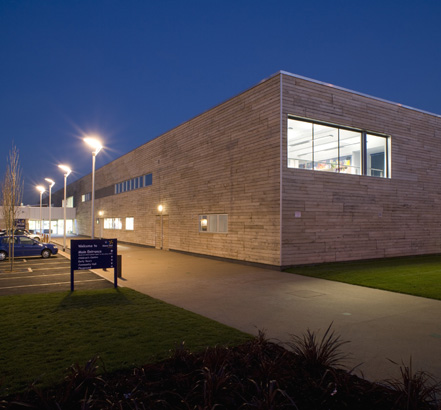
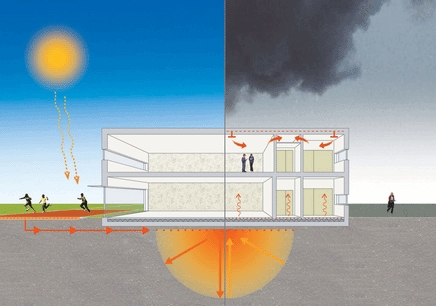
Howe Dell School in Hatfield, Hertfordshire, UK


  • a pioneering heating, cooling and ventilation system which captures renewable energy to warm or cool the building
  • a wind turbine
  • electricity producing photovoltaic panels
  • roof lights and light wells which allow natural daylight to flood into the building, minimising the need for artificial lighting
  • high-performance windows to reduce heat loss
  • classroom sink tops and splash backs made from recycled yogurt pots
  • 'living' sedum roof areas which help to insulate the building and promote bio-diversity
  • a water recycling system


Howe Dell is Hertfordshire’s first ‘Eco-School’.  It is also the first building in the world to feature a revolutionary new heating system that uses the school playground to heat and cool its buildings. It also has many other eco features such as:


NIMBY conflicts


Renewable energy is being used to decarbonise the energy grid but there are issues when it comes to the technology and structures used to harness this energy.
The Not In My Back Yard (NIMBY) refers to those people who do not want these things in their local area or back yard as it's often referred to...they'd totally rather it be in someones's backyard tho!

Not my backyard? Is this really the problem when it comes to wind farms, surely they are miles away from peoples homes? However, even though off shore wind farms are not located in peoples back yard they are still receiving protests when new schemes for farms are being planned and getting complaints about existing farms.

There are two key things to understand about NIMBYism:
1) Procedural justice - issues of how people are told, and when they're told, and how much they're told, and how much of a say they have in any decision-making or governance process
2) Place attachement - refers to the kinds of emotional bonds that can develop between individuals and communities, and the particular places or landscapes or seascapes in which they live, and which are important to them.

Community benefits protocol

Community benefits schemes are a well established, integral part of onshore wind energy development, and represent a positive relationship between developers and communities.

With the aim of formalising the industry’s approach, RenewableUK first launched its Community Benefits Protocol in February 2011. As an industry led and government backed initiative, this protocol was the first of its kind to provide clear industry-wide commitments on community benefit provision. This Protocol was further updated in October 2013 in response to the DECC call for evidence into onshore wind, which concluded in June 2013. This Protocol is supported by DECC and a range of governmental and community stakeholders.
Under the Protocol, developers in England with qualifying projects commit to provide community benefits of £5,000 per MW of installed capacity, or equivalent benefits-in-kind, directly to host communities.
These funds can be used to finance anything the community deems appropriate and necessary for their areas, including community owned renewable energy projects, village halls, recreational facilities or equipment for local schools. Benefits under the Protocol are negotiated directly with host communities.


links:
http://www.arcc-network.org.uk/wordpress/wp-content/D4FC/01_Design-for-Future-Climate-Bill-Gething-report.pdf
http://www.theguardian.com/science/2013/nov/28/drink-local-the-climate-change-act-in-the-lake-district-rebecca-willis
http://www.renewableuk.com/en/renewable-energy/communities-and-energy/community-benefits-protocol/index.cfm